per·i·pa·tet·ic
ˌperēpəˈtedik/
adjective
  1. 1.
    traveling from place to place, especially working or based in various places for relatively short periods.
    "the peripatetic nature of military life"
    synonyms:nomadic, itinerant, traveling, wandering, roving, roaming, migrant,migratory, unsettled
    "I could never get used to her peripatetic lifestyle"
  2. 2.
    Aristotelian.
noun
  1. 1.
    a person who travels from place to place.
  2. 2.
    an Aristotelian philosopher.
Showing posts with label Mushrooms. Show all posts

Wednesday, March 2, 2011

The Nature of Ephemerals--Disappearing Gold in Georgia--Trout Lilies and Other 'Miracles'

Trout lily, Erythronium umbilicatum, seen at Wolf Creek Trout Lily Preserve on Feb. 26, 2011
Seeing is not believing. For this reason, the question whether miracles occur can never be answered simply by experience. Every event which might claim to be a miracle is, in the last resort, something presented to our senses, something seen, heard, touched, smelled, or tasted. And our senses are not infallible. If anything extraordinary seems to have happened, we can always say that we have been the victims of an illusion. If we hold a philosophy which excludes the supernatural, this is what we always shall say. What we learn from experience depends on the kind of philosophy we bring to experience.--C. S. Lewis, Miracles
 I don't blame you for not believing me when I tell you there is gold in Georgia. It's almost gone, though, so don't drop whatever it is you're doing, grab your gold pan, and head for the hills. By the time you get to Wolf Creek Trout Lily Preserve--unless you live nearby--chances are the trout lilies will be done blooming for the year. That's the nature of ephemerals: here today and gone tomorrow. Like the balance in the checking account after paying the bills each month.
Remember that anniversary last Wednesday that SAM and I celebrated? He, sweet man that he is, stopped on his way home from work on Tuesday, February 22, and bought me a potful of calla lilies, a bottle (or two) of wine, and a balloon.
The lovely balloon that he brought home to the apartment in Tallahassee on Tuesday was not the one he had originally chosen and purchased. He said that one was snatched away by a gust of wind just as he was putting it in his truck. Well, guess what? We find it on Saturday, waiting for us in the woods in Georgia. Spirited away there one day and discovered here four days later...

After touring the trout lily preserve, we decide to visit Birdsong Nature Center, another Georgia treasure. At the conclusion of the Butterflies, Bees, and Bats seminar the week before, the couple sitting in front of us compliment me on the banana muffins I have brought to the event. That reminds me! I need to e-mail them the recipe. Better yet, I'll add the recipe to the blog under a new tab and send them a link. The more readers, the merrier! Anyway, after introductions all around and some pleasant conversation, we confess that we are walkers through and through. They think we might enjoy visiting the lily preserve and checking out some other trails in the area. Birdsong, a former plantation full of history and mystery, is high on a list of favorites.

Now, I ask you, what if I had brought store-bought muffins to share and not those homemade ones? Would those nice people have been so helpful and forthcoming with their suggestions and directions? Maybe so, but I think that making a little extra effort butters the serendipity pan, so to speak.

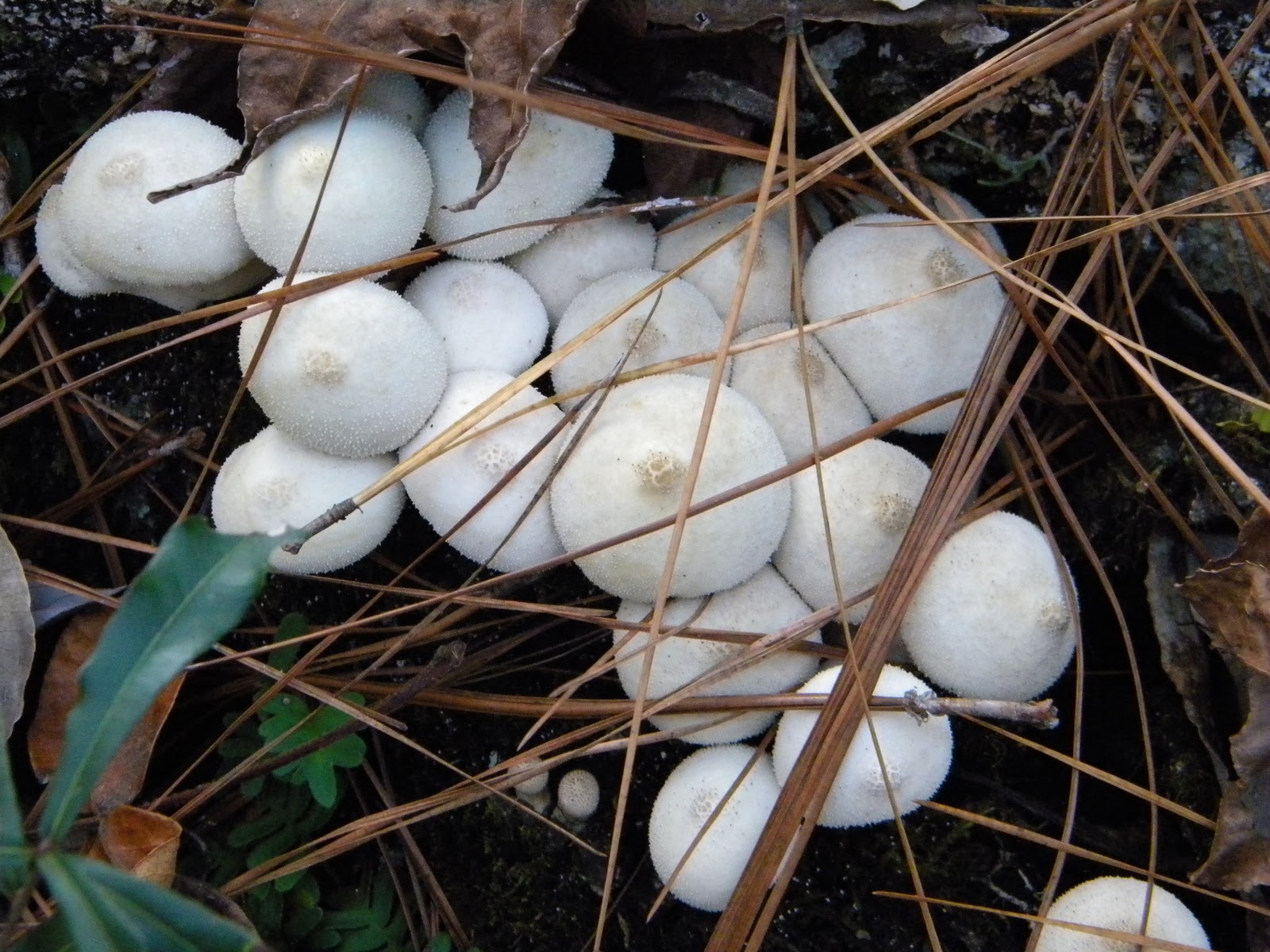
Speaking of buttering the pan...Somewhere along a Birdsong trail, just before we find that errant balloon, we spot these mushrooms growing on a rotting log. SAM convinces me that they are edible. He says his dad used to find the same kind in the woods in Southern Illinois while deer hunting and brought them home for SAM's mom to batter and fry. The ones we find are fresh and tender and, in the nature of ephemeral things, not likely to stay that way for long. So, I figure, why not? We pick one cluster of many that are growing on the log. Cross my heart, that's all we take! Only problem is, we have nothing to put (hide) them in except my camera bag. Would anyone notice? Or care?

Honestly, I don't take plants from their natural setting. The trout lilies were safe with us, notwithstanding the manhandling pictured above. Mushrooms, on the other hand, aren't plants. Here today and here tomorrow, thanks to their mode of reproduction. To my way of thinking, they are suitable game for bagging or snagging, or whatever you want to call it. All's fair in love and spore!

SAM wants to try them grilled, and I prefer them sauteed in butter along with some garlic, wine, and heavy cream, served atop a piece of toast. We divide the haul in half and try them both ways. All of the evidence--if you can believe it--in the nature of ephemerals, disappears without a trace.


The "bird window" designed by Betty Komarek, one of the nature center's founders

 Our impressions of Birdsong, however, will remain with us forever.


One of many well-tended walking trails at Birdsong
 
The Listening Place, a screened pavilion which overlooks Big Bay Swamp

Some artwork to admire while relaxing in front of the bird window


Wednesday, December 29, 2010

Recipe Roundup from the Heart of a 4-H-er


Daughter's heart-healthy Christmas gift basket, emptied of its goodies

After some discussion with my sister and many requests by Daughter to put favorite family recipes online, I will begin to do just that. I mention my sister because I wanted to check with her first in case she had any objections. She has been wanting to get a family cookbook published for some time now with entries from all members--at least the adult ones--but we, as a family, can't seem to get our act together and comply with her wishes. Daughter wants her favorite recipes in one place where she can find them with a few keystrokes rather than searching through a wooden box filled with worn-out, food-stained index cards. Some of them get misplaced too, stuck in between pages of cookbooks to mark some other recipe.

Two of my all-time favorites--most often prepared--are for piecrust and sweet roll dough. Both of them are versatile. The piecrust recipe can be used for dessert pies or main dishes (quiche, for instance). The sweet roll dough can be prepared as dinner rolls or filled with fruit and sugar/spice mixtures for breakfast or dessert. I've been preparing this recipe since my stint in 4-H when I was a teenager. I won a trip to the Illinois State Fair as a prize for winning third place in the Jackson County food demonstration. Whoop-de-do! As I recall, "heart" is one of the H's in 4-H. Does anyone remember what the other three stand for?

As you can probably tell from the ingredients, these recipes would probably not qualify as being "heart-healthy," but if comfort and joy have any value for keeping the old pump working then maybe they shouldn't be entirely eliminated from a diet. Everything in moderation is my motto. It works well with just about anything, including cooking:

Water-Whip Double Piecrust

3/4 cup vegetable shortening (I use Crisco)
1/4 cup boiling water
1 Tablespoon milk
2 cups all-purpose (unbleached) flour
1 teaspoon salt

Measure the shortening in a medium bowl. Add boiling water and milk and whip with a fork until mixture resembles sour cream. Stir in flour and salt until mixture "rounds up" into a ball. Divide in half and place one-half between two pieces of wax paper. Wipe counter top with a wet dishrag and place paper on the moist (not wet) surface. Roll out dough with rolling pin until piece will fit into a 9-inch pie plate and overlap it slightly. Dough will probably be about 1/4-inch thick. Peel off top paper and invert dough onto pie plate, letting it settle in, and then carefully remove other paper. Roll out the other half similarly. It may be used as a top crust or as the base for another pie. Trim and crimp edge as desired. Fill and bake as directed by recipes calling for empty pie shells or double crusts. This recipe is fairly "forgiving" (doesn't usually get tough), but it shouldn't be over-whipped or rolled out repeatedly. You don't want to develop the gluten (glue-like stuff made of proteins in the flour) like you would in the next recipe:

Sweet Roll Dough

Two packets of active dry yeast (not rapid-rise)
1/2 cup of hot water (not boiling but more than lukewarm)
1/2 cup sugar
1/2 cup shortening
1 1/2 cups milk, heated to more than lukewarm
2 large eggs
4 cups all-purpose flour (may use half whole-wheat)
2 teaspoons salt

Dissolve yeast in water. Set aside. Combine sugar, shortening, and heated milk in a large bowl. Stir vigorously for a couple of minutes. Add eggs and beat them into the mixture. Add dissolved yeast and about half of the flour and all of the salt. Stir until mixture is thick. Add almost all of the remaining flour and stir until mixture "rounds up" in the bowl. Put some of the remaining flour on counter and turn dough out of bowl. Begin kneading, adding flour as necessary to keep dough from being too sticky but don't be extravagant with it. Depending on the humidity level in the kitchen and type of flour used, you may need a little more or less than 4 cups of flour. Whole-wheat flour makes the dough a little drier, so less is better. More economical, you might say. My dad once told me that peasants used to console themselves with the thought that their dark bread was healthier than what their "betters" were eating. The whiter their bread, the quicker they're dead was a little rhyme from childhood that still comes to mind today when I make food choices. Continue kneading until dough is smooth and not sticky. Wash mixing bowl and dry. Add a little olive oil to the bowl and place dough in it, turning it over until oil covers the dough. This will keep it from sticking to the bowl. Cover dough lightly with plastic wrap and then a dish towel. Place in warm, dry location to rise for about one and a half hours, until dough doubles in size. Lightly punch the dough down and let rise again for about one-half hour. Divide dough into about four pieces and roll out as desired. I usually make crescent rolls by rolling out each piece into a circle, buttering it, and cutting small wedge shapes which are then rolled up, beginning from the wide end. Place rolls on ungreased baking sheets and cover with paper towels and then dish towels. Let rise until double (about 30 minutes) in a warm, dry location. Bake in a preheated 400-degree (Fahrenheit) oven for about 8-10 minutes. Remove immediately from baking sheets, cool on rack for storage (they freeze well), or enjoy them hot from the oven, slathered in butter! 


Cryptothecia rubrocincta, Christmas lichen, seen at Leon Sinks Geological Area

Mushrooms, maybe Lepista irina, seen at Leon Sinks Geological Area
If my recipes aren't heart-healthy, at least Mother Nature comes through with spectacular results. According to this site, HeartHealthyOnline, researchers have discovered that mushrooms of all things have heart-protective ingredients in them. For starters, there is ergothioneine (isn't that a mouthful?), an antioxidant. Yes, it's true: we start oxidizing or "rusting" inside as we get older. No wonder I creak so much when I move. Then chitin, which is a cholesterol-lowering carbohydrate, helps out. And let's not forget beta-glutan (a chemical associated with healthy hearts), high-quality proteins, vitamins, and unsaturated fatty acids. Selenium is another "ingredient" that protects against cancer.

Mushrooms have never been high on SAM's list of favorite foods. I usually have to sneak them into my quiches and other main dish pies. He doesn't complain too much as long as I don't get carried away. The sweet roll dough, though, is definitely not mushroom territory, unless I use it to make calzone. Now there's a thought!

The writer of this blog does not assume any liability whatsoever for readers' overindulgence and possible weight gain. She's too busy trying to control her own voracious appetite. Please eat responsibly.

Friday, October 9, 2009

Juniper Creek Trail--A Chuck-Norris-Yet-Curious-George Kind of Place


I don't advocate eating wild mushrooms, but finding some with eerily familiar shapes on Juniper Creek Trail last week sent my imagination soaring to new heights. The first one you see here looks a lot like a meringue, don't you think? It's only missing those glistening drops that form as the meringue cools after baking.

***********************************************

"To the Looking-Glass world it was Alice that said

'I've a sceptre in hand, I've a crown on my head.

Let the Looking-Glass creatures, whatever they be,

Come and dine with the Red Queen, the White Queen, and me!'"


Daughter and SAM spotted this one before I did. It could be a veritable feast in the eyes of a survivalist slowly running out of provisions after weeks in the forest. A chicken for every pot, you say? Who needs meat when there's so much soul-food to find along the trail? As Steinbeck's Lennie would say, you could "live off the fatta the lan' " right here.

And hundreds of voices joined in the chorus:--

"Then fill up the glasses as quick as you can,

And sprinkle the table with buttons and bran:

Put cats in the coffee, and mice in the tea--

And welcome Queen Alice with thirty-times-three!"

Angling for the right to be noticed, this wild Blazing Star, Liatris tenuifolia--a member of the Aster family--grows abundantly along the sunnier meadow portions of the trail, not far from where it begins at the tiny parking area. At this time of year, be sure to douse yourself with insect repellant. Once you leave the more open meadow environment and enter the close woods, the flora begins to change, and the fauna with an appetite for human blood will start to annoy you. Actually, there is no "off" season in Florida for those pesky things. You've got to really love the heat--and bugs--to stay in this kitchen. Of course, there are silver linings to every cloud of mosquitoes. Once in a while, you'll find a delicate wildflower like the Climbing Butterfly-Pea, Centrosema virginianum, to take your mind off your troubles.


Then followed a confused noise of cheering, and Alice thought to herself "Thirty times three makes ninety. I wonder if any one's counting?" In a minute there was silence again, and the same shrill voice sang another verse:--

" 'O Looking-Glass creatures,' quoth Alice, 'draw near!

'Tis an honour to see me, a favour to hear:

'Tis a privilege high to have dinner and tea

Along with the Red Queen, the White Queen, and me!' "

You might think the water here is made out of iced tea. It's certainly cold enough, and the tannin that comes from the native oaks gives it a warm gold color, especially on a sunny autumn day. The first inhabitants and then the white settlers who came later found tannin to be quite useful for preserving animal hides and maybe even their own. Mixed with animal fat and some other useful, stinky ingredients, it protected them from stinging, biting insects and too much sun exposure. I wonder what the SPF might have been?


Then came the chorus again:--

"Then fill up the glasses with treacle and ink,

Or anything else that is pleasant to drink:

Mix sand with the cider, and wool with the wine--

And welcome Queen Alice with ninety-times-nine!"


It's kind of sad to think that part of the trail is slowly slipping away, steadily eroding into the river and eventually washing out to sea. On the drive down to the wilderness area, we passed some construction (destruction?) workers cutting trees and removing their stumps from a parcel of land nearby. I hope that whatever they're building is worth the price, and I'm not talking about money. It's hard to say if Florida will ever do a "180" (degree turn) on land consumption. Construction around where we live has almost ground to a halt, which isn't too good for the local economy, but at least the land gets a much-needed shabbath, or rest.


When I zoomed in on the eroded hill, I saw that someone had left his or her mark behind for the whole world to see. I wonder how many years "BJ" will be around for future hikers to find?


"Ninety times nine!" Alice repeated in despair. "Oh, that'll never be done! I'd better go in at once--" and in she went, and there was a dead silence the moment she appeared. Alice glanced nervously along the table, as she walked up the large hall, and noticed that there were about fifty guests, of all kinds: some were animals, some birds, and there were even a few flowers among them. "I'm glad they've come without waiting to be asked," she thought: "I should never have known who were the right people to invite!"


After a long stretch of trail, even iced-tea water starts to look inviting. Not too far past this sand bar where we took off our shoes and waded in, a shelter--built by Boy Scouts--awaits the weary walkers, and there are surprises to be found inside it--no, not the Man in the Yellow Shirt and the girl in the blue shorts.


Curious-George bloggers like to read what other people have to say about this place. What did they see, and what were their impressions of it?


Some thoughtful people are trying to encourage a conversation here.


I hope that Chuck Norris enjoyed our little corner of Florida. I'd like to think that you "Go with God" too, Mr. N--whoever you are--when you walk the trails.

Thursday, October 23, 2008

From the Guileless to the Gullible


My grief, quoth I, is called Ignorance,
Which makes me differ little from a brute,
For animals are led by nature's lore,
Their seeming science is but custom's fruit;
When they are hurt they have a sense of pain,
But want the sense to cure themselves again.
And ever since this grief did me oppress,
Instinct of nature is my chiefest guide.
I feel disease, yet know not what I ail,
I find a sore, but can no salve provide;
I hungry am, yet cannot seek for food,
Because I know not what is bad or good...
...Great Alexander made so great account,
Of Knowledge, that he oftentimes would say,
That he to Aristotle was more bound
For Knowledge, upon which Death could not prey,
Than to his father Phillip for his life,
Which was uncertain, irksome, full of strife....

--from "A Dream" by Rachel Speght, 1621--

I did not take the picture of Micah with the gull. I think it was taken by either my son or daughter-in-law, who e-mailed it to me this week. I forgot to ask who the photographer was. It's a spectacular picture, either way. He looks like he is so close to it that he could hop on and take flight with the bird. Things have a way of fooling adults, who really should know better. My grandmother (dad's mom) was reported to say that babies know everything there is to know about heaven and earth until the moment they say the word "rock." After that moment, they have to relearn everything they have forgotten. I'm not sure where Grandma's theory of learning originated. Maybe it's a fusion of the Platonic versus Aristotelian theories, the nature versus nurture debate that has been going on for centuries and can be found in religious as well as secular writings.


Do not be fooled into thinking this beautiful red plant is harmless. TC (The Write Gardener) knows exactly what it is from experience. His tabula, if it ever was rasa, now contains a lot of writing about this plant since first becoming acquainted with it.


Hubby and I spent a lot of time outdoors this past weekend in Southern Illinois. Kinkaid Lake near Murphysboro, Illinois, holds a lot of memories for us. We used to take a boat to this part of the lake and dive for little trinkets, sometimes even finding gold rings and other jewelry. Young people--usually inebriated--are known to congregate in this part of the lake during the hot summer months and sometimes shed more than just their jewelry. This picture of the dam and spillway makes the spot look fairly harmless, at least this time of year. Probably after today, the dry side of the dam will look anything but dry. It has been raining steadily all day, and it doesn't take long for the lake to fill up from the surrounding hillside runoff.


When we lived nearby, there were frequent reports of slips, falls, broken limbs, and even drownings in the lake and particularly on or around the spillway.


I guess the natural beauty of the area is irresistible to most people who either don't know or choose to forget the natural danger always present there.


Hubby and I picked a good day to explore the spillway. We could choose our path on the rocks, carefully avoiding the ever-present slippery spots and pools of water.


After climbing up the spillway and crossing the barrier fence at the top, we walked on top of the dam to reach another path that might not seem readily apparent to anyone unfamiliar with the area. The Kinkaid Lake trail is all but forgotten, and it seems to be an intended outcome. Concrete barricades block most access, and signs--if they ever were in place--are no longer available to point the way.


To seasoned hikers and former residents like us, a lack of signage is no problem.


We found the trail and a view of the lake from a bluff high above it.


I thought for a moment that I had found some more gold treasure, but this time it was hidden in the trunk of a tree. The memories must have really been working overtime at this point on our hike. Of course, there is treasure in this fungus, if you care to think of it as a valuable, renewable resource on this planet, slowly doing its work of decomposing living matter.


I guess Hubby felt like he had to prove his youthful vitality after finding the fungus. You will never find moss growing on this rolling stone. Maybe fungus, though. We all have it in our bodies in some form or other. Lovely thought, hmm?


The day after visiting Kinkaid Lake, we took a shorter walk at Rend Lake and found this sign greeting us at the beginning of the bike trail. We have been warned, and now we know what that little sign on the trail we saw earlier this year was all about. I like to think that knowledge is power and a way for the imagination to take flight.

Seagulls, as you know, never falter, never stall. To stall in the air is for them disgrace and it is dishonor. But Jonathan Livingston Seagull, unashamed, stretching his wings again in that trembling hard curve--slowing, slowing, and stalling once more--was no ordinary bird. Most gulls don't bother to learn more than the simplest facts of flight--how to get from shore to food and back again. For most gulls, it is not flying that matters, but eating. For this gull, though, it was not eating that mattered, but flight. More than anything else, Jonathan Livingston Seagull loved to fly. This kind of thinking, he found, is not the way to make one's self popular with other birds...
--from Richard Bach's novella Jonathan Livingston Seagull--


Sunday, October 12, 2008

Face the Future--Conserve Energy, Inherit the World, and Become a Saprophyte!


Tapwell: But to my story.
You were then a lord of acres, the prime gallant,
And I your under-butler. Note the change now.
You had a merry time of it--hawks and hounds,
With choice of running horses, mistresses,
Of all sorts and all sizes--yet so hot
As their embraces made your lordships melt,
Which your uncle, Sir Giles Overreach, observing,
Resolving not to lose a drop of 'em
On foolish mortgages, statutes, and bonds,
For a while supplied your looseness, and then left you.

Wellborn: Some curate hath penned this invective, mongrel,
And you have studied it.

Tapwell: I have not done yet.
Your land gone, and your credit not worth a token,
You grew the common borrower; no man scaped
Your paper pellets, from the gentleman
To the beggars on highways, that sold you switches
In your gallantry...

--from Phillip Massinger's A New Way to Pay Old Debts, 1633--

Foraging, it seems, has become fashionable for some people, with more dollars than sense, though their harvest can turn out to be deadly instead of healthy. Is it hard times or just wanting to "go green" that inspires even some wealthy ones among us to act foolishly? Perhaps they think they are godlike in their ability to avoid financial disaster or to summon immediate, expert medical attention, but even they will eventually succumb to the supreme masters of the universe, the lords of the Kingdom Fungi. We are familiar with some royal members of that kingdom by virtue of their fruiting phase, the mushrooms, which thrive in the woods, in our lawns, and in our gardens. These saprophytes, as they are known to biologists, perform important tasks in the environment and really do more good than harm, as long as nature neophytes are wise enough to leave them alone. Mushrooms require little energy to grow or reproduce, and they offer themselves as interesting subjects for observation. The Fishing Guy photo-captured a squirrel devouring a delicious looking fungus but recommends, with good reason, being very cautious about consuming mushrooms found in the wild. Even though a squirrel seems to find them appetizing and can eat them without apparent ill effects, humans are more susceptible to their mycotoxins and cannot expect the same results. We might not be able to consume them all, but we will all--even the rich and famous--become food for them someday.