per·i·pa·tet·ic
ˌperēpəˈtedik/
adjective
  1. 1.
    traveling from place to place, especially working or based in various places for relatively short periods.
    "the peripatetic nature of military life"
    synonyms:nomadic, itinerant, traveling, wandering, roving, roaming, migrant,migratory, unsettled
    "I could never get used to her peripatetic lifestyle"
  2. 2.
    Aristotelian.
noun
  1. 1.
    a person who travels from place to place.
  2. 2.
    an Aristotelian philosopher.

Wednesday, August 25, 2010

Growing Chamberbitter--Mithridates' Curse or Blessing in Disguise?

Chamberbitter, variously known as Phyllanthus urinaria, leafflower, shatterstone, gripeweed, and Bhumyamalaki (Sanskrit) makes itself right at home in my northwest Florida garden. If I didn't know better, I would say it's a noxious weed. It has its way with every flower bed, the veggie garden, and any other cultivated spot in my yard. The seeds it bears on the undersides of its leaves spread easily by design. Every time I pull up one plant by the roots, several dozen more potential plants fall to the ground to take its place. Since it possesses such an obviously aggressive method of reproduction, I just had to know: where did this plant come from and what is it good for? An agent with the Clemson University Cooperative Extension Service thinks it might be something other than a noxious weed. Shawn Jadrnicek calls it "A Valuable Weed [that] Lurks in the Garden." If you click on this link that I've provided, scroll down to read his article. According to him, this weed is anything but noxious. In fact, if ancient Ayurveda practice has any credibility--and who can argue with thousands of years' practice--chamberbitter might well be the answer to my current (perennial) weed dilemma: seek and destroy or harvest and use? Hey, if the vanga sena treatment works--consuming seeds with rice water--I might soon be poo-pooing those gynecological symptoms that menstruating and perimenopausal women consider so burdensome. And that purported benefit would be only the beginning. Look what else chamberbitter has the capability of conquering:
  • anorexia
  • hyperacidity
  • gastric burning
  • peptic ulcers
  • urinary disorders
  • diabetes mellitus
  • skin disorders
  • liver disturbances
  • anemia 
...Therefore, since the world has still
Much good, but much less good than ill,
And while the sun and moon endure
Luck's a chance, but trouble's sure,
I'd face it as a wise man would,
And train for ill and not for good,
'Tis true the stuff I bring for sale
Is not so brisk a brew as ale:
Out of a stem that scored the hand
I wrung it in a weary land.
But take it: if the smack is sour,
The better for the embittered hour;
It should do good to heart and head
When your soul is in my soul's stead;
And I will friend you, if I may,
In the dark and cloudy day...
 
--from "Terence, This is Stupid Stuff," by A. E. Housman, 1896-- 
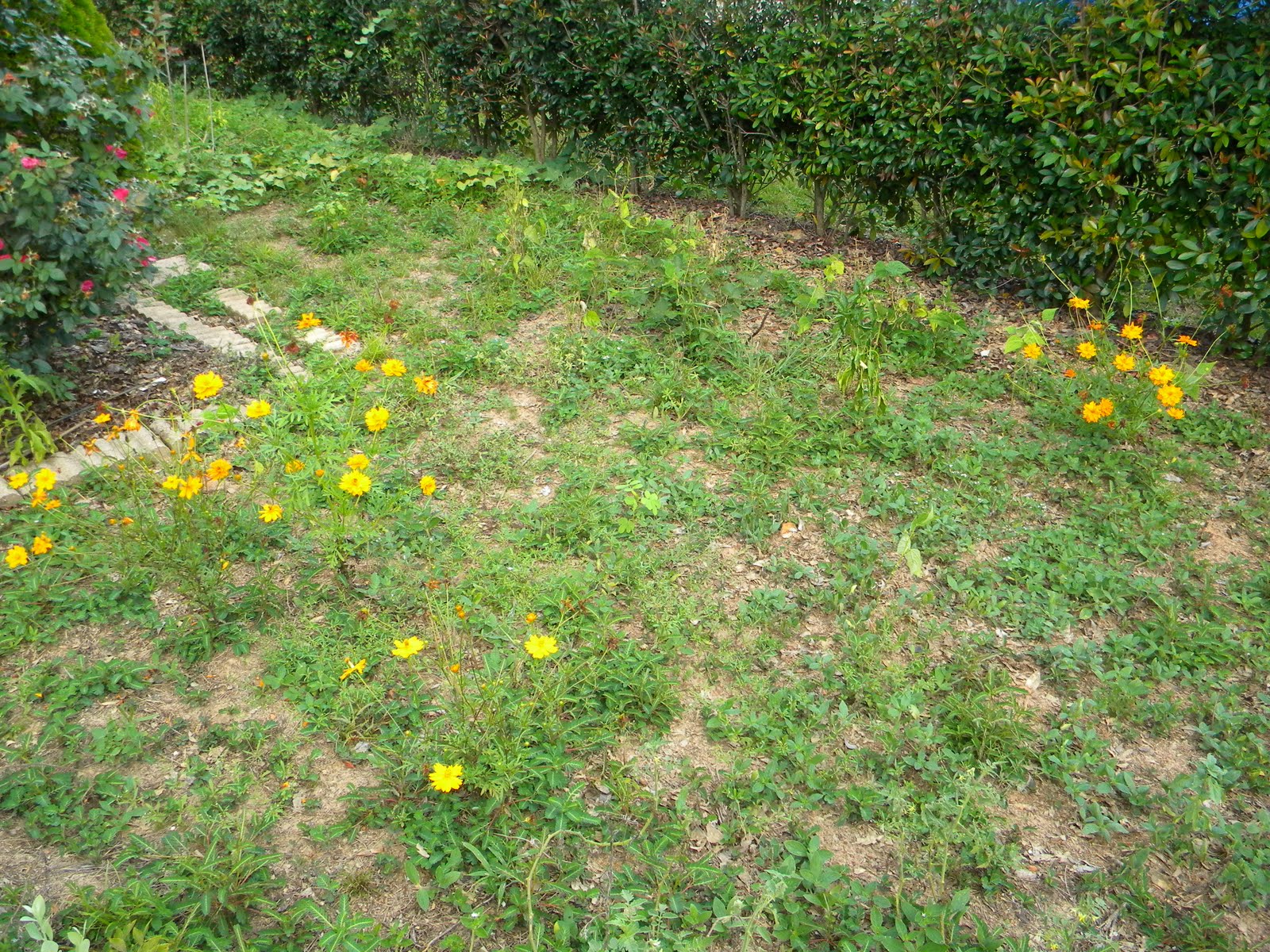
 
If there's any hope for my garden, it might be as a nursery for this pernicious--as most horticulturalists as well as naturalists consider it--weed that came aboard with some other, more delightfully ornamental, horticulturally recommended, exotic introduction to my landscape. The veggies I would like to see growing here don't find the soil or other conditions appealing, but the chamberbitter does for some reason. Could it be that Mithridates has finally found a way to confound the Western modus operandi in the garden of all places?

There, when kings will sit to feast,
They get their fill before they think
With poisoned meat and poisoned drink,
He gathered all that springs to birth
From the many-venomed earth;
First a little, thence to more,
He sampled all her killing store;
And easy, smiling, seasoned sound,
Sate the king when healths went round.
They put arsenic in his meat
And stared aghast to watch him eat;
They poured strychnine in his cup
And shook to see him drink it up:
They shook, they stared as white's their shirt:
Them it was their poison hurt.
--I tell the tale that I heard told.
Mithridates, he died old.

--A. E. Housman, as above--

Friday, August 20, 2010

Ugly is as Ugly Does--Yellow-Necked Caterpillars Turn Beauty on Its Head

Ugly is as ugly does. Now where have I heard that expression before? Not many days after I encouraged those citrus-loving orange dogs to visit and feed freely in my garden, these strange creatures--yellow-necked caterpillars--reared their yellow-collared heads on our blueberry bushes. Oh, dear! What have I done to deserve this kind of attention? I wouldn't say these youngsters are as ugly as the orange dogs. They look rather dapper actually, as if they're dressed to impress. Those are pin-striped suits covered with a hair shirt worn outwards: "Trust me! I can do penance and look good at the same time." Okay, so maybe that interpretation is a little far out. I lay the credit for awakening my curiosity as to why we attach such abstract ideas as beauty or ugliness to things not human at blogger/writer/artist Sarah Laurence's feet. She directed me to a recent article in the New York Times that takes a stab in the dark at explaining our tendency to anthropomorphize. I do agree that I have some "aesthetic prejudices" toward some things in nature, but I don't agree with the article's overall premise that evolution brought me to this point. What would be the point of evolving so far as to see complex human characteristics in something as simple as a lowly caterpillar, if it is indeed "lowly"? There has to be more to it. Literature, perhaps? Reading too much into things? Or maybe just reading too much. If it's a sin, then I am unrepentant. Take Lewis Carroll's Alice in Wonderland, for example. Or maybe you shouldn't. It asks a lot soul-searching questions, and they come from the most unlikely of characters like the hookah-smoking Caterpillar: "'Who are you?'" And "So you think you're changed, do you?" he asks Alice. If you would ask me, I'd say, why yes. I'm not the same person I was in 1960, yesterday, or even 5 minutes ago, in a manner of speaking. And this cute caterpillar won't be as adorable when it grows up. It will look completely different, a plain Jane moth--handmaiden moth. Remember the ugly orange dog? If it survives to become what it's meant to be, it will be nothing short of beautiful, a giant swallowtail butterfly. And there goes that idea of aesthetic prejudice up in smoke. Another blogger, Britta, who is new to me but not to blogging, has recently experienced some prejudice regarding age and beauty, and she has found a creative way to vent her frustration. Hey, if you still got 'em, flaunt 'em. I like her style.

What I don't like is this caterpillar's style. It brings friends to join in the feast. Lots of them. I'll be honest with you. When I spotted these furry critters, of course I had to run and get my camera, tell SAM so he could see for himself, and then quickly find out what they are. Thank goodness for great websites! I wanted to know what kind of damage they could inflict and if it would be fatal to the blueberry bushes. These are still young shrubs and don't have a lot of foliage to spare just yet. I could not get over how many of those pin-striped caterpillars there were! SAM must have picked off at least three dozen of them. Yes, I couldn't stand to see the bushes I've tended so carefully be destroyed. We put the critters on the brush pile in the farthest corner of the backyard. Out of sight, out of mind. Let them fend for themselves, away from the heart of the garden(er). Okay, so I'm a little over-protective when it comes to something I've spent a lot of time on. These bushes have a long way to go before they're finally ready to bear a good crop of berries. Especially now. 

As you can see, they have been robbed--or have they?

Friday, August 13, 2010

Skywatch Friday--Full of Beans in Florida: Jack (Query) and the (Sword) Beans Talk

Looking at this sword bean, Canavalia gladiata, my former mystery plant, soaring up into Florida's summer sky, I make good use of that Wayback Machine on top of my neck and think of one of my favorite fairy tales from childhood, Jack and the Beanstalk. Since it features a plant that surpasses ordinary expectations, a youngster who--with a little help from some magical beans--overcomes his low station in life as well as total submission to a domineering parent, and a conflict with a larger-than-life ogre, I had to ask: what's not to like about this fable? Though there are many versions available in print and now online, the one I remember reading as a child must have been the one written by Joseph Jacobs because while reading it now, I recall how stirred my curiosity was then. Why, for instance, would a young boy be allowed to take his family's most precious asset, a milk cow, to market by himself? Where's the community support for a poor widow who would be desperate enough to sell her main source of sustenance and income? What kind of mother would scold and punish her son for negotiating a bad deal when she should have at least accompanied him to the marketplace? How did the strange man who traded Jack the magic beans for the cow know Jack's name? And, who could believe that a boy who stole repeatedly from another person--ogre or not--and then caused his death would be exonerated and then acclaimed enough to marry a princess? I still don't know the answers to the other questions, but I have decided that Jack's mysterious benefactor knew Jack's name because of the French connection. It is, after all, the Anglicized form of the term "Jacque" given to peasants from at least as far back as the mid 14th century. Apparently, it had something to do with the short coat that peasants wore to signify their station in life--the 14th century version of a blue collar. Did the French Revolution have its origins with malcontents epitomized by a short Corsican fellow who was often portrayed by 18th and 19th century artists with his hand stuffed in his jacket, or was there a precedent to that popular unrest? A much earlier revolt or clash between the classes in France took place in 1358 and is known as the Jacquerie. Accounts of knights being roasted by the peasants--Jacques--and served up forcibly to the knights' families were spread by chroniclers--journalists?--of the day. It's kind of strange that those chroniclers, also members of the ruling class, neglected to report a possible rationale for the revolt and its alleged butchery. You know, things like burdensome taxation of the peasant class, corruption and gross abuse of power amongst the elites, and a lack of government protection for ordinary citizens left to fend for themselves against invading marauders--unemployed soldiers and other bandits--from England, Gascon, Germany, and Spain. Now that I think about it, Jack's ogre's insatiable appetite makes perfect sense. He is a giant in the greatest sense of the word--a conglomerate representative of corporate greed, government corruption and control, and media malfeasance all rolled into one colossal eating machine, nourished by and living high above the means and heads of everyone else.

Getting back to the story, would the ordinary, late-19th-century-until-present-day consumer of light-as-a-feather fairy tales be able to stomach this rags-to-riches-by-murder tale penned by a scholar educated at St. John's College, Cambridge University? You can bet on it. Mr. Jacobs gambled and won on the premise that people all over the world were beginning to understand that, class standing notwithstanding, we're all cut from the same cloth. It's one of those timeless truths that, if given some consideration, topples all kinds of giant misconceptions about each other. I think that given the right opportunity and circumstances, there's bound to be a bit of both the trickster Jack and the giant in all of us. Of course, I could be full of beans. 

When I consider every thing that grows
Holds in perfection but a little moment;
That this huge stage presenteth naught but shows
Whereon the stars in secret influence comment;
When I perceive that men as plants increase,
Cheered and checked even by the selfsame sky,
Vaunt in their youthful sap, at height decrease,
And wear their brave state out of memory;
Then the conceit of this inconstant stay
Sets you most rich in youth before my sight,
Where wasteful Time debateth with Decay
To change your day of youth to sullied night,
And all in war with Time for love of you,
As he takes from you, I ingraft you new.

(William Shakespeare, Sonnet #15)

To "ingraft you new" or jog your memory on the glory of this former mystery plant's birth, I'll set Walk2Write's other Wayback Machine--the blog--to a day at the end of April. Its parent bean didn't have to survive a beating but did require a dose of vinegar to coax it into breaking through a tough seed coat so that it could begin its prodigious growth spurt. Though not full of beans yet, it has the potential for a long, productive life growing behind our pole barn. The soil there had been enriched for years by the cows that the original property owner raised. Not surprisingly, it's one of the few spots in my yard that has some decent soil.  

Since I'm not around to check on its daily progress, it's a mystery to me what happens to the rest of the beans that begin to form from these delicate pink flowers. So far, only the one bean that's pictured above has reached maturity. What could be preventing the youngster from reaching its full potential as an adult plant, full of beans? I'll enumerate and eliminate the possibilities:


  1. Adequate moisture. Even though I'm not able to water the plant when the rains don't appear regularly, it grows within the drip line of the pole barn roof, and there is enough evening dew from Florida's ever-present summertime humidity to keep it hydrated.

  2. Sufficient sunlight. The sword bean plant grows on the east side of the barn and receives at least six hours of direct sunlight, enough to satisfy just about any kind of veggie.

  3. Soil pH. I've checked the pH in this part of the yard and found it to be within the recommended limits for growing veggies, which are between 5.8 and 6.5.

  4. Pollination. If you have been following this Wayback Machine for a while, you will remember that Mr. and Mrs. Zucchini Blossom had some problems getting their act together with the bees, but beans are supposed to be self-pollinating and usually don't require much intervention besides a little help from the wind. Wouldn't it be nice if overcoming every other obstacle in life were that simple?   
Please visit Skywatch Friday for more sky perspectives from around the world.

Tuesday, August 10, 2010

That's My World Tuesday--Orange Dog Days of Summer in Florida

Now that the dog days of summer in the northern hemisphere are almost over, I thought it only fitting that the orange dog caterpillar, Papilio cresphontes, should get some face time on the blog. It might not be pretty now, looking like something a bird had for breakfast, but that ugly visage will change soon enough. A giant swallowtail butterfly will emerge from a chrysalis that the caterpillar forms for itself. It seems like magic every time it happens, and I don't mind a bit that the orange dog is feasting on my pink grapefruit tree. It must be the mother in me that keeps saying "Eat, eat, and have some more!"

For more That's My World Tuesday stories this week, please visit the official site and check out what other bloggers have posted.

Friday, July 30, 2010

Skywatch Friday--Sinkhole Sunset at Lake Jackson

I'm especially fond of sunsets, and even more so these days. When I'm looking west, can you guess where my thoughts are headed? The apartment complex where we now live most of the time sits close to a park that's adjacent to a fascinating geological phenomenon--a sinkhole lake. Lake Jackson is on the rebound, filling up, regaining its depth and breadth in a cycle of drain/regain that usually begins every 25 years. I took this picture in early June, shortly after SAM and I moved to Tallahassee where he works. It looks like autumn has arrived already because most of the leaves on the trees have disappeared. Most of these trees, though, are not dormant. I think they are dying. They might not have a problem with "damp feet," but their roots will not survive being flooded. They started growing here when the main body of the lake lay elsewhere and the soil that it used to cover was at that time dry enough to support them. 

The native Americans who originally settled here called this place Okeeheepkee, or "Disappearing Waters." I found a fascinating account of one man's exploration of it that dates from 1842. You can probably guess from this excerpt what political party he favored at that time:
"...I think of nothing which will interest you more than our near neighbor Lake Jackson, which I shall prove to be as self-willed and unreasonable a body of water for a lake as the Whigs fancy they have proved its illustrious namesake to have been as a president and a man..."

 
Please visit Skywatch Friday for more sky perspectives from around the world.

Tuesday, July 27, 2010

Some Real Southern Comfort--Manatees, Mamas, Homemade Pies, and a Backyard Bouquet

I've been cooling my heels and soothing my spirit lately with some real Southern comfort. No, not that stuff in a bottle that some people think is whiskey. A few weeks ago, Son and his family visited us in Tallahassee, and we took them to Wakulla Springs. It was a hot day with intermittent rain showers, which is typical weather for Florida at this time of year. We wanted them to experience the boat tour we had taken this past winter, but the threat of thundershowers postponed the departure several times. When we finally got underway, we were treated to several manatee sightings, including this one of mama manatee with her youngster. As you can see, the water is much more clear at this time of year as compared to the last time we visited the park.

Micah didn't seem to mind the wait at all. He spent a lot of time building his own version of castles in the sand. At least on this little beach, the tide won't take them down. His mom and I kept an eye on him while Son and SAM tested the coolness of the water. According to our boat guide for the tour, it stays right around 68 degrees Fahrenheit year-round. 

...The life in us is like the water in the river. It may rise this year higher than man has ever known it, and flood the parched uplands; even this may be the eventful year, which will drown out all our muskrats. It was not always dry land where we dwell. I see far inland the banks which the stream anciently washed, before science began to record its freshets... (from Walden, Chapter 18: Conclusion, by Henry David Thoreau)

...Everyone has heard the story which has gone the rounds of New England, of a strong and beautiful bug which came out of the dry leaf of an old table of apple-tree wood, which had stood in a farmer's kitchen for sixty years, first in Connecticut, and afterward in Massachusetts--from an egg deposited in the living tree many years earlier still, as appeared by counting the annual layers beyond it; which was heard gnawing out for several weeks, hatched perchance by the heat of an urn. Who does not feel his faith in a resurrrection and immortality strengthened by hearing of this?...


It might not be as naturally refreshing as spring water, but the pool at home lets us enjoy the outdoors at a time of day when we would normally be found inside keeping cool in the air conditioning. Son doesn't often get to savor moments like this one. I hope I don't sound too corny here, but I'm going to say it anyway. Son is one of my heroes. He works harder than anyone I know, outside in Florida's summertime heat and humidity, lifting heavy drilling augers, and toting sacks of Portland cement and bentonite. He started this kind of work ten years ago when his dad and I started an environmental service company. Son didn't know what he wanted to do with his life at that time, tried college and quit, so we took the plunge and invested our savings and borrowed money to start a family business. We had just bought our first drilling rig and began to find work in West Kentucky when 9-11 came along and knocked the wind out of this country and most of our prospects for business. State money--much of it from gasoline taxes--for testing and cleanup of contaminated sites was diverted elsewhere as the nation's fast-flowing economy began its slow but steady decline to a trickle. Private work at factory sites dried up too as companies began tightening their belts. We moved south to Florida because SAM and Son were traveling so often to work there. The work that seemed so plentiful at first on the east coast disappeared within a few months, and we packed up again to move to our home near Pensacola. With the state funding squeezed so tightly that it was gasping for breath within a couple of years of moving there, SAM and I decided it was time to sell the company. We needed to get out while the gettin' was still good. But what would Son do now? He had met his true love, gotten married, and acquired a mortgage. SAM found him a decent paying job with a company that had bought some of our equipment. Son has been working there ever since, but the work is beginning to take its toll on his body. Somehow, he finds the strength and time to take college courses after working 50-60 hours a week. He has some goals in mind, and he's taking the necessary steps, painful though they may be, to achieve them. Now do you understand why I admire him so much? I wish that we had sold our home earlier this year so we could help him financially. Apartment life isn't so bad, and I'm getting used to the Tallahassee area--meeting new gardening friends, hiking (when it's cooler), and paddling the many spring-fed rivers in the area. 
 Some of Nature's handiwork can be seen along the Chipola River.


A couple of weekends ago, we found a great blue heron resting from its fishing work at Wacissa. Wouldn't you love to have that job?

 
This past weekend, after some wistful remarks by SAM that he had not tasted a lemon meringue pie in a very long time, I decided to bake some Southern comfort for Sunday dessert. Along with a cheesecake baked by daughter-in-law, the lemon pie and a blueberry cream pie rounded out a meal of barbequed ribs, homemade macaroni and cheese and tossed salad. If not for the heat outside and the calendar reminding us that it's still July, it could have been Thanksgiving Day.


Between rain showers and right before dinner on Sunday, I threw together some hastily gathered flowers and took a picture so I could participate in Noelle's (Arizona Plant Lady) Monthly Garden Bouquet meme. What's blooming and otherwise showing its color in my backyard and other garden areas at this hot time of year? Colocasia esculenta 'Black Magic,' Rudbeckia 'Goldsturm,' Spanish lavender, hydrangea 'Endless Summer,' and some unknown hosta. I also added some fern leaves to the vase. I hope you enjoy my version of Southern comfort. 

...Who knows what beautiful and winged life, whose egg has been buried for ages under many concentric layers of woodenness in the dead dry life of society, deposited at first in the alburnum of the green and living tree, which has been gradually converted into the semblance of its well-seasoned tomb--heard perchance gnawing out now for years by the astonished family of man, as they sat round the festive board--may unexpectedly come forth from amidst society's most trivial and hand-selled furniture, to enjoy its perfect summer life at last!...